

WILL WE GET CLARITY?
05/17/26 Prospero.ai Investing - 319th Edition (Weekend)


One of the most groundbreaking technologies of our lifetime was just sent to the Senate for approval. If it passes, it will change our lives in substantial ways and the crazy part, fortunes will be made in the process. So let’s jump in.
For more than ten years, the American crypto industry has been operating like a driver squinting through a windshield smeared with mud. The road is there. The traffic is moving; sometimes really fast. But none of the drivers know the rules of the road. Is the speed limit 25, 75 or 125 mph? Does that flashing light mean stop, or go? Is that your lane or mine? As a result, investors, founders, banks, and regulators have all been driving blind together; and the fender-benders have been expensive. This week, somebody finally grabbed the wheel, a good squeegee and finally gave us some CLARITY.
1. What is the CLARITY Act?
The Digital Asset Market CLARITY Act of 2025 is the most comprehensive piece of crypto regulation ever to make serious progress through Congress. At the risk of oversimplifying a 309-page bill, here’s the headline: it places every crypto asset into one of three clearly defined buckets.
1. Securities — tokens that behave like stock or an investment contract. Think of a token that represents a share of a startup’s future revenue, or one issued by a project whose value depends entirely on the founding team executing on a roadmap. If your return rides on someone else’s effort, it’s probably a security. These stay under the SEC; the same agency that regulates Apple and Tesla stock.
2. Digital commodities — these are tokens like Bitcoin and Ethereum that are tied to a decentralized blockchain. They are now officially going to be classified as digital commodities (think oil) No CEO controls them; they run on open code and a global network of computers. These move under the CFTC, the agency that already regulates oil, gold, and corn futures.
Stablecoins — digital dollars. This is a BIG DEAL. A stablecoin is a crypto token engineered to always be worth exactly $1, backed by a company that holds real cash and U.S. Treasuries in reserve for every token it issues (the two biggest are Tether’s USDT and Circle’s USDC). Here’s why this is a game changing technology. Because they live on a blockchain, they move at internet speed for pennies in fees.
Real-life example: instead of paying $40 and waiting three business days to wire $1,000 to a family member overseas, you can send the same $1,000 in stablecoins from your phone in under a minute for less than a dollar in fees. Game changing! But there’s a problem. BANKS HATE THE CLARITY ACT and the stablecoin issue has been why bank lobbyists have been fighting it tooth and nail. If it passes, banks stand to lose between $30-$40 BILLION Dollars annually on payment related fees. But guess who was fighting tooth and nail against the automobile industry when it first started? The folks that made horse drawn carriages.
2. What Just Happened
On Thursday, May 14, the Senate Banking Committee voted 15–9 to advance the CLARITY Act to the full Senate floor. The bill had been frozen in committee for four months over a fight about whether stablecoin issuers can pay holders yield (banks said no, crypto said yes).
This was not the finish line. CLARITY still needs:
• Sixty votes on the full Senate floor,
• Reconciliation with the House version that already passed last summer.
• President Trump’s signature.
Supporters are targeting a July 4 desk signing, but real risk remains. Law enforcement groups, the banking lobby, and the AFL-CIO are all still pressing against pieces of the bill. Polymarket currently places odds of around 62–69% of it passing in 2026. Senator Cynthia Lummis has warned that if the bill misses this window, it could effectively be pushed to 2030.
3. The Real-World Implications
For the everyday American, CLARITY is a big deal. If it passes:
• Expect Bitcoin and Ethereum exposure to start showing up inside more 401(k)s, IRAs, and traditional wealth platforms.
• Stablecoins — already a $200+ billion market — get a real legal home in the U.S. payment system. That has implications for everything from cross-border payments to how your employer might one day pay you. You know how your bank doesn’t always instantly deposit your paycheck into your account? That would go away.
• The DeFi pipeline (decentralized exchanges, on-chain lending, tokenized real-world assets) receives explicit legal protection in the U.S., reversing five years of “build it offshore” pressure.
The critics aren’t wrong to flag risks. If stablecoins can compete with bank deposits for yield, that’s real pressure on the deposit base that funds American mortgages and small business loans. Law enforcement is genuinely worried that some of the bill’s DeFi carve-outs make anti-money-laundering work a lot harder. These are open questions that the final draft will need to address.
For crypto and crypto stocks specifically:
The market reaction Thursday was strong. Coinbase (COIN) jumped roughly 10%. Strategy (MSTR) climbed 6–8% as a clearer legal backdrop reduces risk on its 713,000-Bitcoin treasury. Marathon Digital (MARA) rallied 5–7%. Robinhood (HOOD), Bitmine (BMNR), and other crypto-adjacent stocks all caught the bid. This also explains why MSTR and COIN were showing such strong Net Options Sentiment Numbers over the past several weeks!
4. Short-Term View on Bitcoin and Ethereum
Here is the part that may surprise people: the price reaction in the actual underlying assets was the most muted part of this whole story.
Bitcoin briefly tagged $82,000 on the vote and is now hanging around $79,500 — squarely inside the $74–82K consolidation range it has held all spring. The 200-day exponential moving average around $82,000 has been a stubborn ceiling since early May. Above $82,000, more than $550 million in short positions become vulnerable to liquidation, which is the structural setup that could fuel a quick squeeze and things can get crazy. Until BTC closes meaningfully above $82,000 with sustained ETF inflows behind it, the most honest read of the chart is “coiled but not yet broken out.”
Ethereum is more cautious. ETH is trading around $2,255 and is structurally weaker than Bitcoin. It has spent months locked between $1,760 support and $2,380 resistance, with every upside test rejected. ETH’s real CLARITY catalyst isn’t the commodity label itself — it’s the legal foundation for staking ETFs and DeFi protections, which take quarters, not weeks, to translate into flows.
Prospero’s read: the muted price action is a textbook “buy the rumor, sell the news” reaction layered on top of the procedural reality that CLARITY still needs 60 Senate votes. Short-term, expect chop. The structural setup, however, is materially better than it was a month ago. If the bill is signed by July 4 or shortly after, the institutional inflow cycle that started with the Bitcoin ETFs in January 2024 has a clear path to broaden out across the entire digital asset complex. If it stalls, the downside case, something in the neighborhood of a 15–25% correction across the space, becomes a real likelihood.
For now, the windshield is starting to clear. The road ahead is just becoming visible. The smart move isn’t to go “all in” with Ethereum and Bitcoin. But I personally have begun to accumulate some in my Self-Directed 401k. Tom Lee made the announcement last week that his Ethereum price target for the next couple of years is $65,000. If he’s only ¼ right, there’s a lot of money to be made in this space. So let’s watch our net options sentiment. Be smart with our accumulation, and when it takes off, let’s ride this train as far as it will take us. Exciting times.
A WORD FROM OUR CEO
We had a fantastic week start to the week, but got caught up a bit on the Friday drop. Overall we are a little better than last week and staying consistent even with the chop we have started to see. We are currently 39% above the market on an annualized basis, with a 57% win rate against SPY benchmarks.
Our short intro + learning videos get you up to speed on how best use our letters and app to increase your wins.
Back to our usual stream schedule this week 5/18 at 11 AM ET and 5/20 at 3 PM ET
Track all of your investments in real time with our app. Prospero’s proprietary AI tech updates key options signals like Net Options Sentiment, Upside and Downside every 3 minutes.

WILL WE GET CLARITY?
Market/Macro Update w/ Cap/ Value Analysis
QQQ and SPY Net Options Sentiment
Sector Analysis
How we view the Sector performance and momentum
Portfolio Strategy
Putting it all together to make a portfolio that first controls for risks but also has upside
Longs
Adds —> Keeps —> Drops
Shorts
Adds —> Keeps —> Drops
Portfolio Summary
CAP / VALUE ANALYSIS
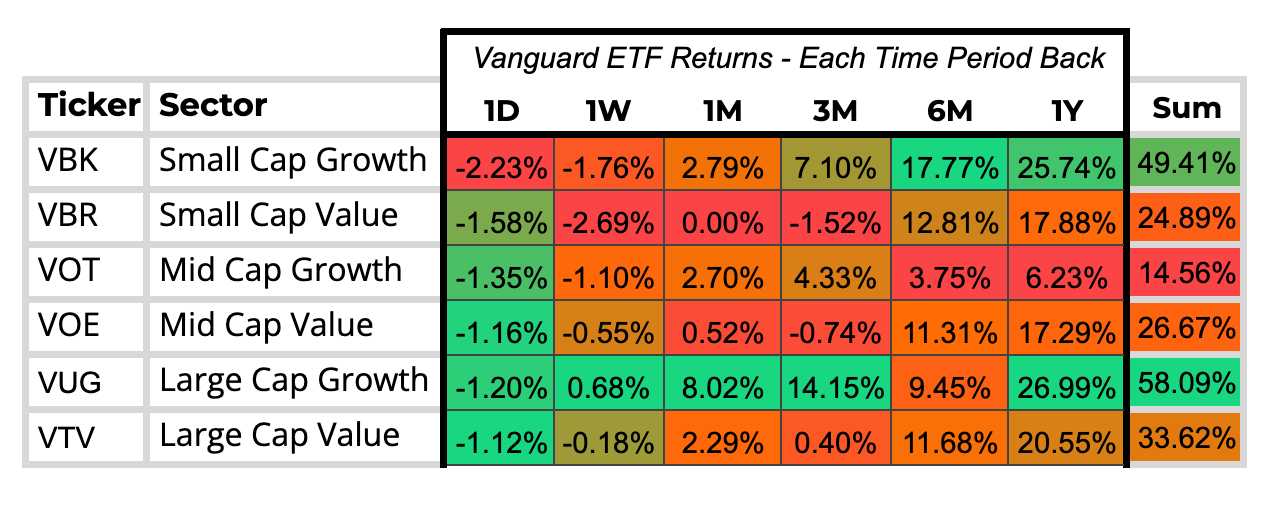
When you focus on the 1-week data, a very clear picture emerges of where capital is hiding. Large Cap Growth was the solitary bright spot on the entire board, managing to stay in the green with a 0.68% gain. Meanwhile, investors actively rotated out of the smaller, higher-beta names. Small Cap Value suffered the most severe weekly outflow, dropping over 2.5%, closely followed by Small Cap Growth which ended down 1.76%. The message this week is undeniable: in a choppy environment, the market is overwhelmingly seeking safety in massive Large Cap Growth leaders and actively abandoning the lower-tier caps.
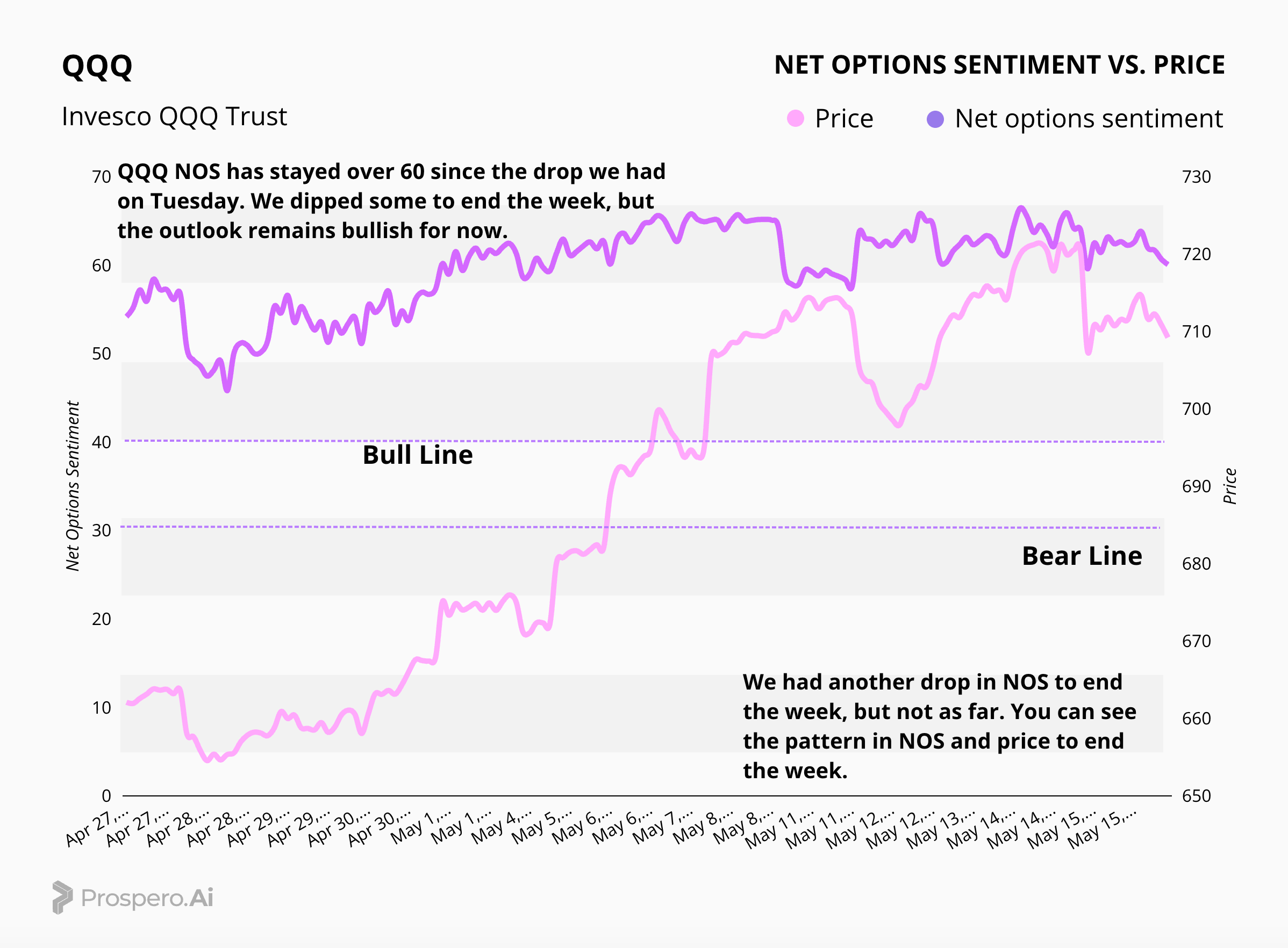
While we saw a slight dip in both price and QQQ Net Options Sentiment to close out the week, the underlying momentum remains incredibly robust. Despite a pullback on Tuesday, NOS has resiliently held above the 60 level, demonstrating that the bulls are still firmly in control. This minor end-of-week chop mirrors the price action but doesn't change the broader narrative; as long as sentiment stays elevated at these levels, our outlook remains firmly bullish.
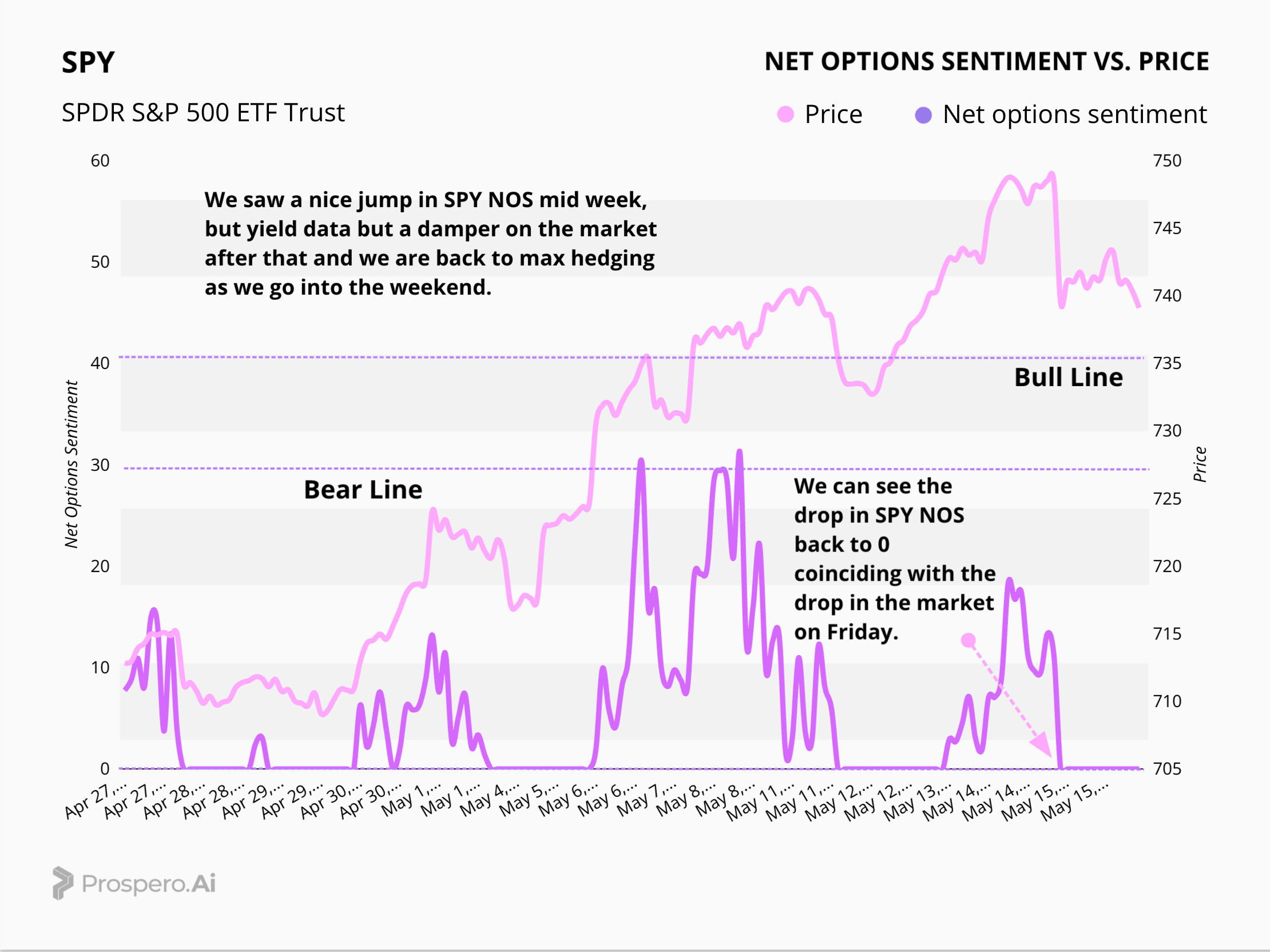
While we saw a promising midweek spike in SPY Net Options Sentiment, macroeconomic factors quickly threw cold water on the rally. Yield data put a damper on the broader market, sending NOS plummeting right back down to the zero line as we closed out the week. You can clearly see on the chart how this aggressive retreat in sentiment on Friday coincided perfectly with a sharp drop in the ETF's price, reminding us that the broader market is still highly sensitive to macro headwinds even while tech continues its historic run.
SECTOR ANALYSIS
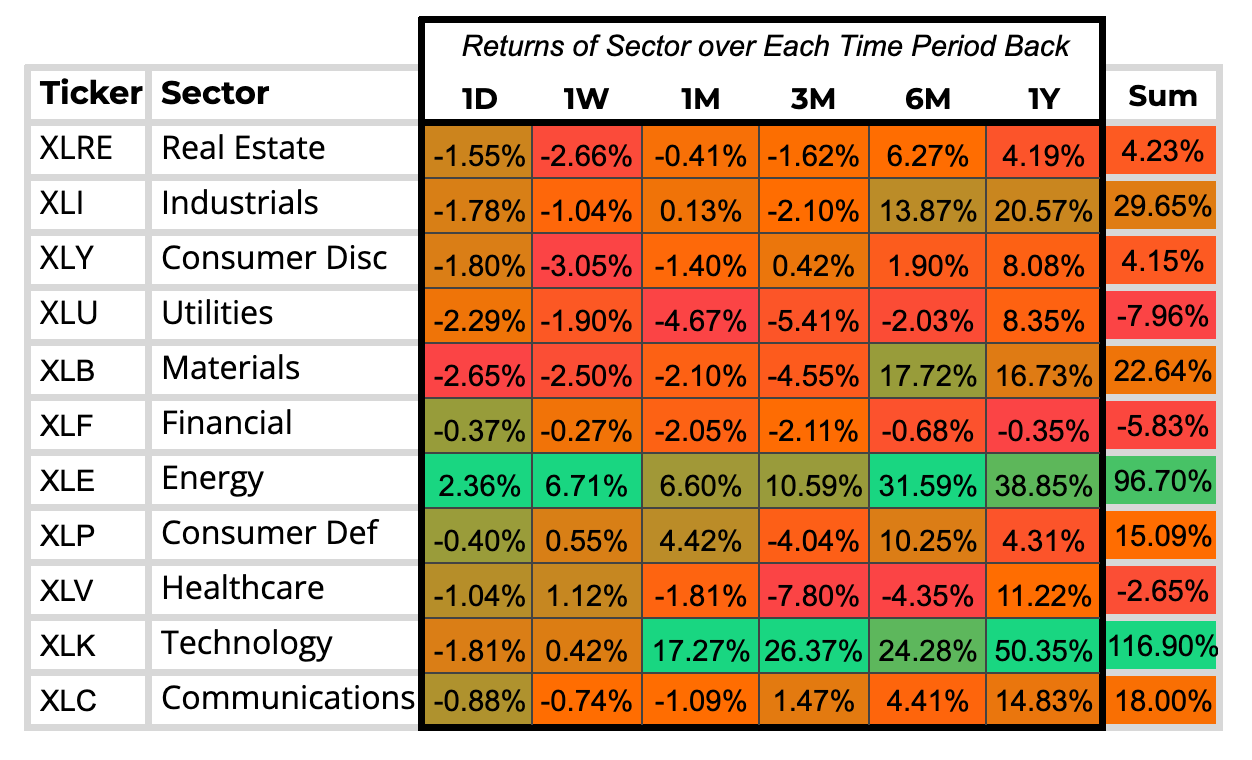
Looking strictly at the 1-week data, we are seeing a massive rotation into Energy, which completely dominated the board with a surge of nearly 7%. Aside from Energy, the market took a decidedly defensive posture to weather the chop. Healthcare and Consumer Defensive were the only other notable bright spots, posting modest gains of around 1% and 0.5% respectively, while Technology just barely kept its head above water.
On the flip side, capital actively fled riskier and rate-sensitive areas. Consumer Discretionary took the hardest hit, dropping over 3%, closely followed by Real Estate and Materials, which both bled over 2.5%. The momentum this week clearly shows investors seeking shelter in Energy and traditional defensive names while actively dumping cyclical and discretionary sectors.
PORTFOLIO STRATEGY
QQQ Net Options Sentiment remains strong, but overall Tech was mostly flat last week and there has been concerning macro data piling up. We are still leaning bullish, but maintaining a more neutral stance with 6 longs and 5 shorts.
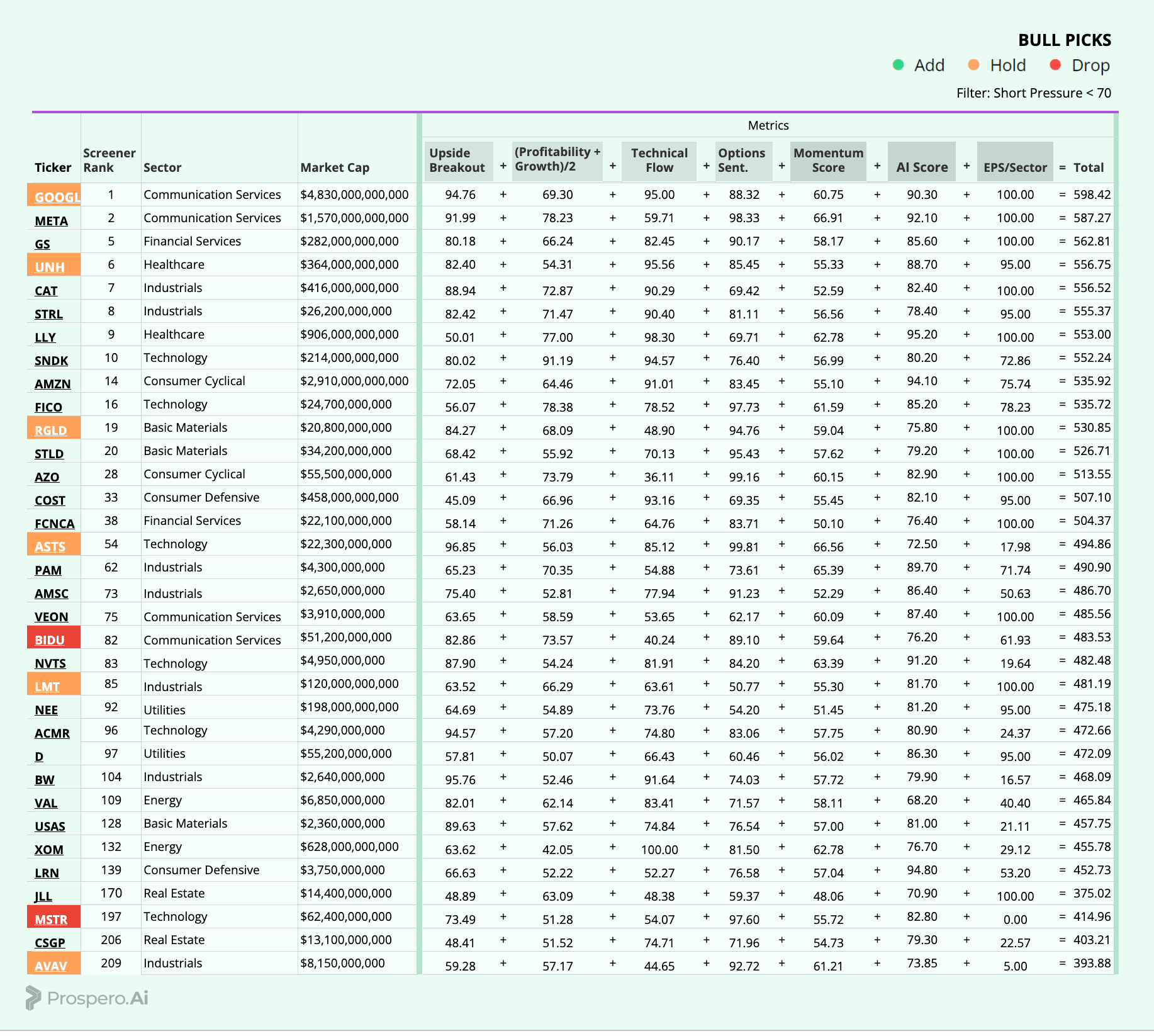
Long / Bull Moves – GOOGL, MSTR, UNH, RGLD, ASTS, AVAV Holds / MSTR, BIDU Drop
Adds
None
Holds
Our longs have performed great the last couple weeks, and the data continues to show why we are letting them ride. ASTS is flashing massive strength in Technology, standing out with a 97 upside score. UNH is a clear keeper for Healthcare momentum, anchored perfectly by a stellar 96 tech flow. GOOGL continues to lead Communication Services, driven heavily by a massive 95 tech flow. Rounding out the group, RGLD offers a solid 84 upside score for Materials. Finally, we are maintaining our Industrials exposure with AVAV, leaning on its strong 93 net ops, and LMT, which continues to hold its ground with a steady 64 tech flow.
Drops
BIDU was dropped as its Tech score went down after the Trump China visit, MSTR was dropped for its lower Upside and to reduce volatility.
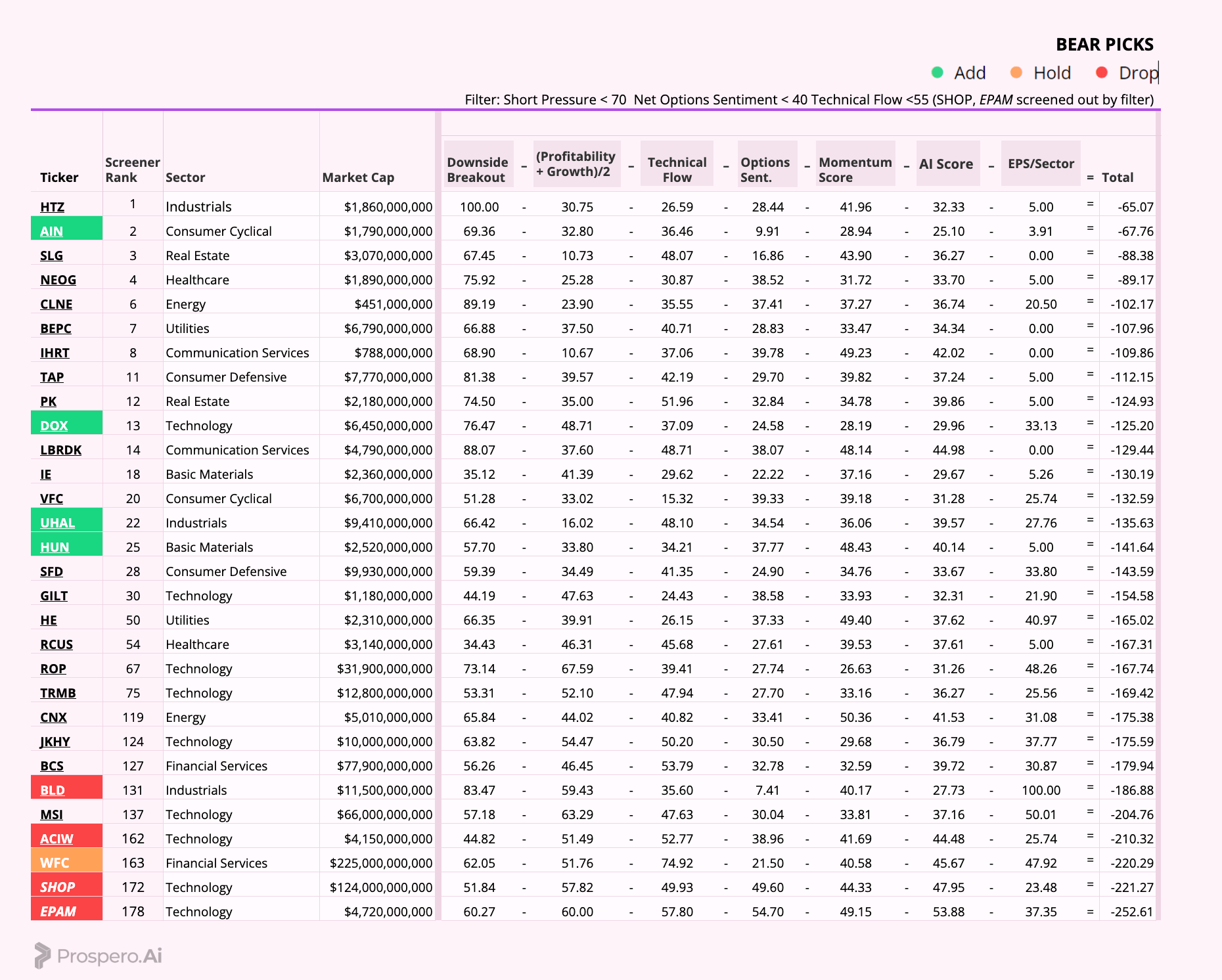
Short / Bear Moves – AIN, DOX, UHAL, HUN Adds / WFC Hold and BLD, ACIW, SHOP, EPAM Drops
Adds
AIN was added for its single digit Net Options Sentiment, DOX was added for Tech exposure with low Momentum and AI score. UHAL was added for its poor Profitability and Growth, and HUN was added as Materials has been a weak sector and its high downside.
Holds
WFC was kept for its poor Net Options Sentiment.
Drops
SHOP and EPAM were filtered out. BLD was dropped for its strong Profitability and Growth and ACIW was dropped for its higher Tech Flow and rising Momentum Score.
Portfolio Summary
Long / Bull Moves – GOOGL, AVAV, RGLD, UNH, ASTS, LMT as holds / BIDU and MSTR drops
Short / Bear Moves – AIN, DOX, UHAL, HUN Adds / WFC hold / SHOP, ACIW, SHOP, EPAM as drops
6 Longs: GOOGL, AVAV, RGLD, UNH, ASTS, LMT
5 Shorts: AIN, DOX, WFC, UHAL, HUN

 | A guest post by
|